White paper
Abundance or Scarcity
Two cultures for the AI moment, what each gets right, what each gets wrong, and why the best operators run both.
Two companies hit the same moment. AI got good enough to absorb a large share of routine work, and each had to decide what to do with the capacity it freed.
IKEA’s franchisee, Ingka, put a chatbot named Billie on the phones. By 2023 it handled about 47% of customer enquiries. Ingka did not cut the call-centre staff. It asked what the bot could not do, found unmet demand for interior-design help, and retrained about 8,500 of those workers as remote design advisers. By the close of FY22, Ingka tied EUR 1.3 billion in revenue to that remote channel, and it is still running: in FY2025 it served more than 73,000 planning customers.
Meta hit the same moment and reached for the other lever. In 2026 it cut about 8,000 jobs, roughly 10% of the company, to fund its AI push, after a 2025 round that cut people some of whom were rated at or above expectations. In nearly the same breath it said it was moving 7,000 people into new AI teams. Mark Zuckerberg said the company had made mistakes.
It is tempting to call one of these wise and the other foolish. That is the easy version, and it is wrong. What separates them is not virtue. It is two different cultures, each with a real logic, each correct under different conditions. One treats the capacity AI frees as a cost to harvest. The other treats it as value to deploy. Call them scarcity and abundance. The useful question is not which is good. It is when each is right, why most companies default to one of them by reflex, and what AI does to the stakes of that default.
The claim this paper will ground is narrow and, I think, true. When AI frees capacity, a scarcity culture removes the cost and an abundance culture redeploys the value, and both can create real money. But they fail in opposite ways, the conditions that favor each are knowable, and the companies that win the AI decade are not the ones that pick a side. They are the ones that can run both: cut what is truly stranded, and grow into everything else. AI does not change that logic. It raises the stakes, because the capacity it frees is larger and arriving faster than any wave before it.
The one question. When AI frees capacity, do not start with “how many can we cut.” Start with one question: can this freed capacity create more than it costs, somewhere in the business? If yes, deploy it, into higher-value work or into more output from the same people. If no, cut it cleanly and humanely. The reflex is to cut. The discipline is to ask first.
The two cultures, and what each gets right
A scarcity culture is an execution culture. It prizes focus, margin, speed, and accountability, and it treats freed capacity the way it treats any slack: as cost to be removed. At its best this is not small-minded, it is exactly right. Costco earns roughly $807,000 of revenue per employee to Walmart’s $324,000, on a fraction of the product range, by refusing complexity. Toyota’s production discipline has compounded into a moat for decades. And when a business line is genuinely stranded, disciplined cutting works: IBM under Gerstner cut more than 100,000 jobs and lifted revenue per employee from $215,000 to $310,000 while exiting commodity hardware; Ford under Mulally cut 30,000, sold the luxury brands, and ran the stock up 920%; Microsoft wrote off the entire $7.6 billion Nokia deal, cut the phone unit, and went on to $3 trillion. Cutting a dying line to fund a living one is strategy, not a failure of nerve.
An abundance culture is a growth culture. It treats freed capacity as fuel: redeploy the people into higher-value work, or use the same people to do more. The performance data is real and larger than the slogans suggest. Over twenty years, the most consistent innovators beat the MSCI World by 2.4 points a year, and the gap is widest in downturns. McKinsey’s “innovative growers,” companies that are both high-growth and high-innovation, beat the Global 2000 median by 11 points of shareholder return a year. And the cost of the opposite, a fearful and disengaged workforce, is not soft: Gallup puts it at $8.9 trillion a year, about 9% of global GDP. A workforce that is afraid does not just feel worse. It measurably produces less.
What each gets wrong
Scarcity’s failure mode is that it calcifies, and at the extreme it eats the company. The tombstone is GE. Jack Welch cut 118,000 jobs and ran the market cap from $14 billion to $600 billion, and for fifteen years it looked like genius. Then the financial engineering the cutting enabled stopped hiding the hollowed-out core, the value fell by more than half, and GE was broken into three. Cutting can flatter the numbers for a long time while the thing that makes a company worth something quietly walks out the door. And the fear a cut-first culture breeds is the same fear that stops anyone from trying the thing that might renew it.
Abundance fails in the mirror image. Undisciplined, a growth culture spends money it does not have on bets that do not land. Peloton lost $2.8 billion in a single year building for demand that evaporated, and the 2022 technology layoffs were one long correction of growth-culture overhiring. Worse, abundance can be faked. AT&T ran a celebrated $1 billion program to reskill 100,000 people, and over the same stretch its workforce still fell by more than 100,000. “We will reskill” with no real place to redeploy is the fig leaf the critics warn about, and it is more cynical than an honest cut, because it dresses the cut in the language of investment.
Abundance is two things, not one
The IKEA story makes abundance sound like it requires inventing a billion-euro business. It does not. Abundance comes in two forms, and the humbler one is the one that travels.
The first is reskilling into new, higher-value work. IKEA moved phone staff into design. Aviva pointed people freed from routine claims at the complex ones and reported tens of millions in savings and a 65% drop in complaints. JPMorgan’s contract-reading system redirected 360,000 lawyer-hours a year from rote review into judgment.
The second is throughput: the same people producing more. Mayo Clinic put hundreds of AI models into radiology and grew its radiologists by 55%, using the technology to absorb rising volume rather than to shrink the team. This is abundance without a new revenue channel, just more of the core work done by the same people, and it is the version that fits a large operational workforce, because it does not depend on conjuring a new business. It is also more honest in a model, because more output is easier to measure than a hypothetical new line.
When to cut and when to grow
The honest core of all of this is a condition, not a slogan. Cut when the freed capacity has nowhere valuable to go. Nokia’s handset lines and Kodak’s film labs were not failures of imagination; there was no adjacent demand to redeploy into, and stretching to invent one would have been the dishonest move. The downsizing research is consistent on the nuance: deep reactive cuts made under distress tend not to pay, while proactive cuts made while a company is still healthy enough to reinvest can. The test is whether you are cutting to fund renewal, or cutting because the quarter demands it.
Grow when there is adjacent value and you are willing to reinvest in the business you keep. IKEA had latent design demand. A fulfillment operation has more volume to serve. A claims desk has complex cases waiting. Where that value exists, harvesting the capacity as pure cost leaves the larger prize on the table.
Seen this way, Meta is not the opposite of IKEA. It is the same fork answered by reflex. Meta had somewhere to put people, it was hiring 7,000 into AI roles at the very moment it cut 8,000, but it ran the move through a layoff and a fear culture instead of a redeployment. Some of those cuts were genuine skill-mix changes that no reskilling could bridge, a content moderator is not an AI researcher, and that is a fair point. But cutting people rated at or above expectations teaches everyone who remains a single lesson: no one is safe. And in a company where no one is safe, no one will volunteer to automate their own job, which is the one thing a company most needs people to do.
The move most companies miss
That last point is the keystone, and it is where the cultures diverge most sharply. Your most capable people are the ones who could most fully automate their own roles. In a scarcity culture they never will, because doing so would be handing in their notice. So the company’s best people, the ones who would learn AI fastest by building with it, are exactly the ones the culture has trained to hide it.
Flip the incentive, for the people best positioned to use it. Make it safe and rewarded for your strongest people to automate their own work, and you get three things at once: the work gets cheaper, those people become genuinely fluent in the tools because they built the automation, and you have your most capable talent freed for the work only a person can do. That is how a company actually learns AI, from the inside, through the people it already trusts.
The objection is fair. A written promise not to cut people who automate themselves is worth little in a bad quarter, and Meta just proved that “at or above expectations” is no shield. So do not make it a blanket pledge. Make it a track record. Redeploy the first cohort visibly, before the next planning cycle, and let the proof do the persuading. Trust here is not built by a memo. It is built by who is still in the building a year after they automated their own job.
What it’s worth
This is where the argument has to be honest, because the easy version, a chart where abundance always wins, is a sales prop, not analysis. The real question is not whether redeploying beats cutting. It is how much value the freed capacity has to create to beat a disciplined cut.
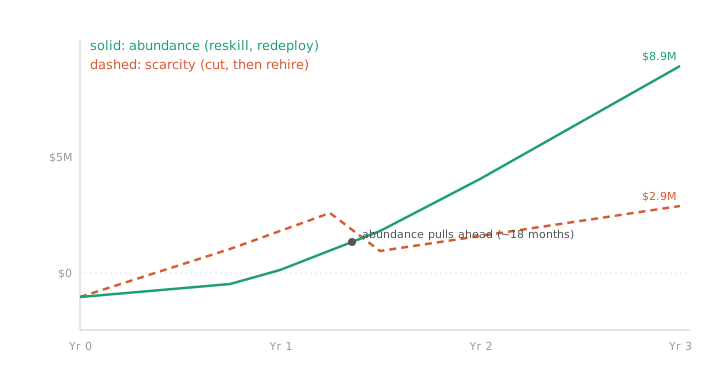
So model it that way. Put a disciplined cut on one side: take the savings, do not churn through expensive rehiring, bank a real and durable number. Put abundance on the other: spend to reskill, absorb a learning dip, then create value, either new revenue or more throughput. The output is not a verdict. It is a break-even.
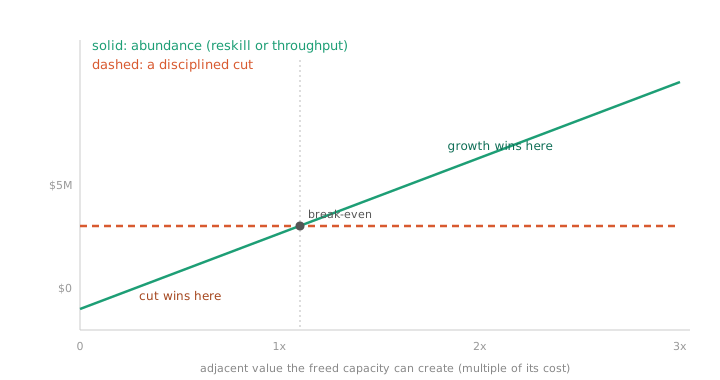
Below the break-even, when the freed capacity has little adjacent value, the disciplined cut wins, and you should take it. Above it, when the capacity becomes real output or new revenue, abundance pulls away and keeps climbing, because saved cost has a floor and created value does not. The whole decision is which side of that line you sit on, and the honest work is estimating your own adjacent value before you choose, not after. A model that skips that step is selling you something. (You can run your own inputs; replacement cost is 50 to 200% of salary, reskilling averages about $24,000 a head, which is 70 to 92% cheaper than replacing.)
Where to start, and what to watch
The playbook is the same whether you lean cut or grow, because it forces the honest question first.
- Optimize a real, high-volume process and measure the capacity it actually frees, not what a vendor promised.
- Before you free the people, find the adjacent value. Name the higher-value work or the additional volume the freed capacity can serve. If you cannot name it, finding it is the project.
- If the value is there, deploy: reskill toward it, or grow throughput into it. If it genuinely is not, cut cleanly, and do not dress it up as a reskilling program you have no intention of honoring.
- Reward your best people for automating their own jobs, and prove the redeployment before you ask the next person to trust it.
- Manage to the multi-year number, not the quarter. The cut looks better for two quarters. The break-even is decided over three years.
Three honest cautions. Scarcity is sometimes simply correct, and a paper that pretended otherwise would be doing the very thing it accuses others of; when the capacity has no adjacent home, cutting humanely beats pretending. Abundance at scale rarely means everyone keeps their exact job forever; it usually means a workforce reshaped through growth and attrition rather than through a layoff event, and that is a truth worth saying plainly rather than hiding behind the word “redeploy.” And the gains do not distribute themselves: higher productivity can flow to shareholders, customers, or workers, and the technology does not decide which. An abundance culture that captures all of it at the top is just a slower scarcity wearing a friendlier word.
You cannot cut your way to growth, and you cannot grow without discipline
A scarcity culture sees AI and counts what it can remove. An abundance culture sees the same machine and asks what its people could become. Each is right somewhere. Each fails alone, scarcity by hollowing out, abundance by floating away. The companies that win the next decade will not choose between them. They will cut the truly stranded with discipline and grow into everything else with nerve, and they will use the capacity AI frees to make their people worth more rather than simply fewer.
IKEA put a bot on the phones and grew a business out of the people it freed. Meta cut, rehired, and admitted mistakes. GE cut its way to a record and then to a breakup. The technology in front of each was the same. What differed was the culture, the conditions, and the honesty about which was which. That is the whole decision, and AI has only made it larger.
Sources
- Ingka Group newsroom, IKEA AI and remote selling (29 June 2023); FY2025 update via PYMNTS (2026). https://www.ingka.com/newsroom/ai-and-remote-selling-bring-ikea-design-expertise-to-the-many/ ; https://www.pymnts.com/news/artificial-intelligence/2026/ikea-turned-8500-call-agents-into-design-consultants/
- Meta 2026 cuts and AI redeployment (NPR; NBC); Zuckerberg “mistakes” (HR Executive). https://www.npr.org/2026/05/20/nx-s1-5826917/meta-layoffs-ai-jobs ; https://www.nbcnews.com/tech/tech-news/meta-layoffs-ai-rcna345968 ; https://hrexecutive.com/metas-zuckerberg-weve-made-mistakes-in-ai-transformation/
- BCG, Most Innovative Companies 2025 (+2.4pp); AI reshapes more jobs than it replaces (June 2026). https://www.bcg.com/press/26june2025-winning-the-innovation-race ; https://www.bcg.com/press/3june2026-ai-reshaping-jobs-faster-than-companies-reshaping-work
- McKinsey, Innovative Growers (+11pp), 2023. https://www.mckinsey.com/capabilities/strategy-and-corporate-finance/our-insights/innovative-growers-a-view-from-the-top
- Gallup, $8.9T disengagement cost (2024). https://www.gallup.com/workplace/393497/world-trillion-workplace-problem.aspx
- Throughput/redeploy cases: Mayo Clinic radiology +55% (Becker’s); Aviva claims (McKinsey); JPMorgan COIN 360,000 hours (ABA Journal). https://www.beckershospitalreview.com/radiology/mayo-clinic-radiology-leads-in-ai-use/ ; https://www.mckinsey.com/capabilities/tech-and-ai/how-we-help-clients/rewired-in-action/aviva-rewiring-the-insurance-claims-journey-with-ai ; https://www.abajournal.com/news/article/jpmorgan_chase_uses_tech_to_save_360000_hours_of_annual_work_by_lawyers_and
- Disciplined-cut cases: IBM/Gerstner; Ford/Mulally; Microsoft/Nokia; Costco vs Walmart revenue/employee. https://mbaknol.com/management-case-studies/case-study-ibms-turnaround-under-lou-gerstner/ ; https://www.platform01consulting.com/insights/corporate-turnaround-stories-ford-motor-company-2006-2010 ; https://fortune.com/2024/01/24/microsoft-3-trillion-market-capitalization-ceo-satya-nadella-apple-rivalry/ ; https://bullfincher.io/companies/costco-wholesale-corporation/revenue-per-employee
- Failure modes: GE/Welch (MIT Sloan); AT&T reskilling vs headcount (Fortune); Peloton/blitzscaling (HR Brew). https://sloanreview.mit.edu/article/did-jack-welch-blow-up-the-business-world/ ; https://fortune.com/longform/att-hr-retrain-employees-jobs-best-companies/ ; https://www.hr-brew.com/stories/2022/12/06/how-over-hiring-during-the-pandemic-led-to-the-rash-of-layoffs-in-2022
- Replacement cost 50-200% (SHRM/Gallup); reskilling 70-92% cheaper, ~$24k (WEF). https://waterfallplanning.com/learn/the-real-cost-of-employee-turnover/ ; https://pierpoint.com/blog/upskilling-and-reskilling-economic-impact/
- Downsizing-performance literature (proactive vs reactive nuance). https://www.frontiersin.org/journals/behavioral-economics/articles/10.3389/frbhe.2024.1237750/full